



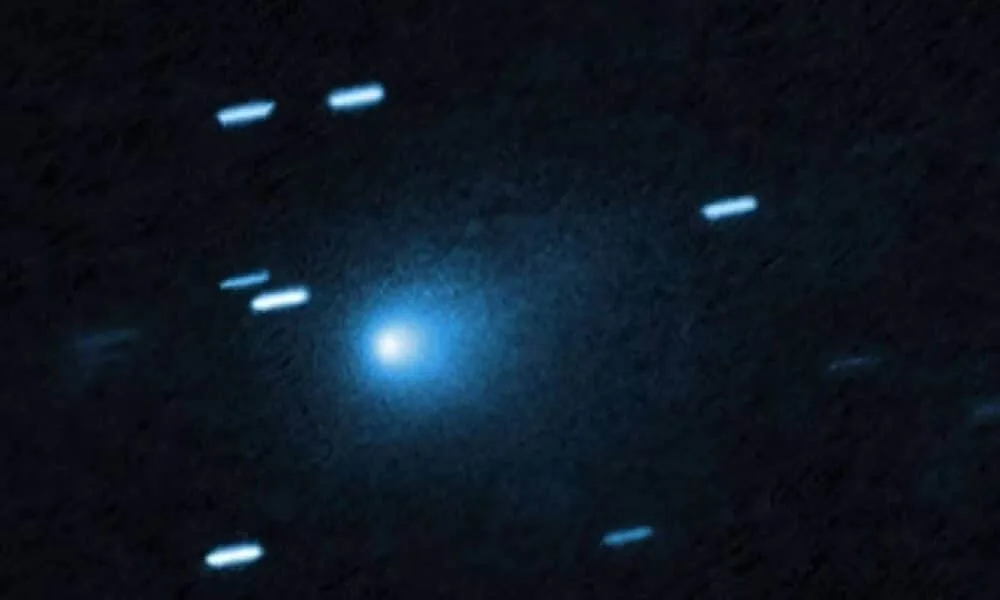

Cometa 3I – Atlas – Foto: NAsa
Astronomers confirmed the detection of the interstellar comet 3I/Atlas by the ATLAS system on July 1, 2025. The telescope, located in the Atacama Desert, Chile, identified the object during routine observations of asteroids. Its hyperbolic trajectory, with a speed exceeding 30 km/s, indicated an origin outside the Solar System.
The comet, the third known interstellar visitor, follows an orbit not linked to solar gravity. It reached perihelion on October 29, 2025, 1.4 astronomical units from the Sun. This passage allowed detailed analyzes of its chemical composition.
Preliminary data reveal the presence of water vapor and carbon monoxide in the coma.
- High concentration of carbon dioxide differentiates the object from local comets.
- Spectra show enrichment in iron and nickel, suggesting prolonged exposure to radiation.
- Cometary activity detected since May 2025, 6.4 AU from the Sun.

Unique chemical composition
Comet 3I/Atlas displays a reddish coma, the result of fine dust released during the solar approach. Hubble Space Telescope observations, carried out on July 21, 2025, confirmedthis characteristic. The release of gases occurred without significant outbreaks, maintaining constant brightness.
Analysis by the James Webb Space Telescope detected water ice and carbon dioxide emissions in August 2025. These elements indicate formation in a cold and distant environment.
Trajectory and speed
Orbital calculations indicate that 3I/Atlas was ejected from another star system billions of years ago. Its escape velocity exceeds 61 km/s, confirming its interstellar nature. The object crosses the orbit of Mars in December 2025.
During perihelion, the comet lost more than 13% of its mass due to the sublimation of ice. This loss caused non-gravitational acceleration, measured by ground-based telescopes. Observations from the Very Large Telescope in Chile recorded nickel vapor on multiple days.
The hyperbolic trajectory, with eccentricity above 6, guarantees exit from the Solar System. Models predict reduced visibility after January 2026.
- Current position: behind the Sun, seen from Earth.
- Minimum distance to Earth: 1.8 AU, no risk of collision.
- Continuous monitoring through international networks.
Global Notes
The ATLAS system, funded by NASA, operates at multiple impact warning sites. Its detection of 3I/Atlas marked the first identification of an interstellar object by an Earth monitoring network.steroids. Telescopes in Hawaii and Australia contributed precovery data.
The TESS satellite captured images of the comet between May and June 2025, before the official discovery. These observations revealed a marginal coma at 6.4 AU.
Differences with previous visitors
Compared to 1I/Oumuamua, from 2017, 3I/Atlas shows clear cometary activity, with a gaseous tail. Unlike 2I/Borisov, from 2019, it has a higher proportion of CO2. These variations highlight diversity in interstellar compositions.
The object may have formed in the galaxy’s thick disk, a region rich in heavy elements. Its estimated age exceeds 7 billion years, before the formation of the Solar System.
Spectral analyzes indicate the absence of certain organic compounds common in local comets.
Contributions to astronomy
3I/Atlas studies expand understanding of ejections in distant stellar systems. SPHEREx data confirmed CO2 emissions in mid-August 2025.
The Vera C. Rubin Observatory in Chile enhances future detections of similar objects. Networks like the International Asteroid Warning Network coordinate precise astrometry.
- Instruments involved: James Webb’s NIRSpec for material mapping.
- Radio observations look for hydroxyl emissions.
- Forecast: more discoveries with advances incelestial surveys.
The comet accelerates beyond 40 km/s after perihelion, crossing planetary trajectories without interactions. Its passage reinforces the importance of continuous monitoring for cosmic visitors.