

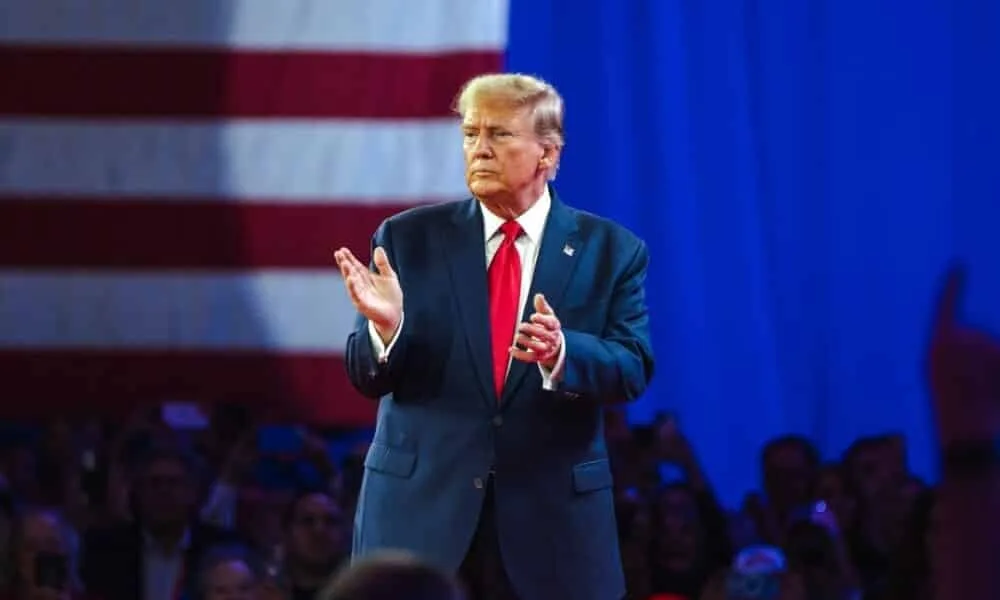

Donald Trump – Foto: Jonah Elkowitz / Shutterstock.com
The White House issued a pointed social media message targeting Venezuelan President Nicolás Maduro on October 17, 2025, in Washington, D.C. The post featured the acronym “FAFO,” shorthand for a profane warning, alongside a video clip of President Donald Trump confirming Maduro’s overtures for economic concessions to ease bilateral strains. This comes as the U.S. ramps up military deployments in the Caribbean and authorizes covert intelligence activities against the Caracas regime, which Washington deems illegitimate.
Trump, speaking during a meeting with Ukrainian President Volodymyr Zelenskyy, acknowledged the proposals but underscored Maduro’s reluctance to provoke further American involvement.
U.S. officials maintain that the regime’s ties to drug trafficking and authoritarian control necessitate sustained pressure, rejecting any partial accommodations.
The exchange highlights a breakdown in prior diplomatic channels, shifting focus to enforcement measures.
FAFO post stirs immediate backlash in Caracas
Venezuelan officials labeled the White House’s message as psychological intimidation tactics shortly after its release. Maduro’s government reiterated calls for direct negotiations, denying any intent to escalate regional conflicts.
The video clip, shared on the official White House X account, captured Trump’s candid response to queries about reported concessions, amplifying the administration’s unyielding posture.
Rejected proposals detail resource swaps
Maduro’s team proposed granting U.S. firms priority in oil and gold ventures during backchannel talks that spanned several months. The plan aimed to redirect energy exports away from partners like China, Iran, and Russia in exchange for lifted sanctions.
Key elements included:
- Full access to existing and upcoming extraction sites for American companies.
- Reversal of petroleum shipments from Asia to North American markets.
- Termination of competing contracts in mining and energy sectors.
Washington dismissed these incentives, viewing them as insufficient to address core issues of governance legitimacy and narcotics involvement. The offers surfaced amid five U.S. airstrikes on suspected trafficking vessels in the Caribbean since September, resulting in 27 fatalities.
Negotiations, led initially by U.S. envoy Richard Grenell, collapsed in early October when Trump halted outreach, frustrated by Caracas’s resistance to immediate leadership changes.
The administration elevated a bounty on Maduro to $50 million for narcotics-related charges, signaling no compromise on accountability.

CIA directive signals covert shift
President Trump disclosed on October 15 his approval for CIA-led lethal operations within Venezuelan territory. The classified order permits unilateral or joint missions targeting regime-linked threats, with the explicit aim of ousting Maduro.
Intelligence sources describe the strategy as dismantling a purported “narco-terrorist” network, extending activities across Venezuela and adjacent waters.
Trump refrained from specifics on potential strikes against high-level figures but noted the regime’s growing unease over possible ground actions.
This follows B-52 flyovers and the staging of over 6,500 troops in southern Caribbean bases last week.
Military maneuvers heighten regional alert
Special operations helicopters conducted flights within 100 miles of Venezuelan shores on October 16, described by a U.S. defense official as standard drills rather than invasion rehearsals.
Venezuela countered by deploying 123,000 Bolivarian Armed Forces personnel and mobilizing up to one million civilian militias for defensive exercises in urban and coastal zones.
- Activation of 284 battle fronts nationwide for rapid response.
- Fortification of key infrastructure in mountainous and border areas.
- State of emergency declaration since September to streamline defenses.
The U.S. Navy’s presence, comprising about 10% of its active fleet including destroyers and carriers, underscores the scale of deterrence efforts. F-35 jets have joined aerial patrols, while sanctions continue to squeeze Caracas’s economy.
Maduro addressed supporters in a broadcast, advocating for peaceful resolution and accusing the U.S. of fabricating drug claims—asserting Venezuelan forces intercept 70% of inbound Colombian narcotics, with only 5% transiting the country.
Transition scheme falls flat
Venezuelan intermediaries suggested a phased handover where Maduro would exit office in three years, transferring authority to Vice President Delcy Rodríguez to serve out the term until 2031.
The White House rebuffed the outline, citing doubts over the current administration’s validity and demands for full democratic reforms.
Discussions, facilitated partly through Qatari channels, also explored deportation flights and energy pacts but yielded no progress.
Maduro publicly mocked the leak as divisive propaganda, while Rodríguez denounced it on social media as fabricated interference.
His regime plans to raise the matter at the UN Security Council, framing U.S. moves as breaches of international norms.
Opposition gains underscore divide
The Nobel Peace Prize awarded to opposition figure Maria Corina Machado in 2025 has bolstered anti-Maduro sentiment, with Trump hailing her as a democratic beacon.
Caracas condemned the honor as external meddling, tying it to heightened U.S. rhetoric.
Venezuela recorded peak oil exports this month following partial sanction relief in February, yet economic woes persist amid the standoff.
The impasse risks broader Latin American instability, as neighboring states monitor deployments warily.