


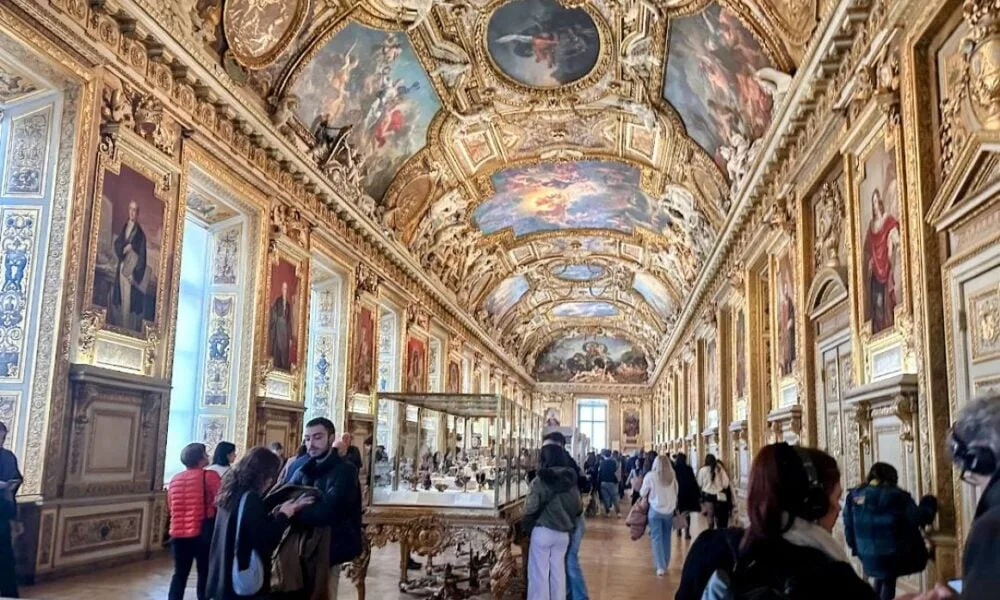
Thieves invaded the Louvre Museum in Paris on Sunday morning (19) and stole nine jewels from the Napoleon Bonaparte and Empress Eugenie collection in the Apollo Gallery. The heist lasted seven minutes and occurred shortly after the museum opened to the public at 9:30 a.m. local time. French authorities confirm the items hold inestimable historical and patrimonial value.
Interior Minister Laurent Nuñez reported that three or four individuals used a crane mounted on a truck to access the site. They broke a window with a power tool and fled on scooters, leaving one damaged piece behind.
Investigators highlight the operation’s precision.
- The thieves targeted two specific display cases.
- They used professional tools for quick cutting.
- An abandoned scooter was found near the Seine.
No visitors or staff were injured during the immediate evacuation.
Invasion details reveal meticulous planning
The robbers entered through a construction area adjacent to the museum, using a pre-positioned cargo lift. Two accessed the inner gallery, while others stood watch outside. The operation began with the window cut, allowing display cases to be broken in under a minute.
They fled toward the Seine, where a recovered jewel, including Empress Eugenie’s crown with 1,354 diamonds and 56 emeralds, was found damaged. Authorities estimate the group monitored the museum for weeks, identifying low-security moments at opening.
Stolen pieces include Napoleonic-era items
The targeted collection houses French Crown Jewels, assembled by kings and emperors. The nine stolen items include a necklace, brooch, and tiara, all linked to the First and Second Empires.
These pieces symbolize imperial splendor and were displayed in themed cases in the Apollo Gallery. The 140-carat Regent Diamond, mounted on a sword used in Napoleon’s 1804 coronation, remained untouched.
The theft directly impacts the historical collection, with items dating to the 19th century. Heritage experts are assessing initial damages, but the focus remains on full recovery.
Security history exposes Louvre vulnerabilities
The incident follows debates over protection in French museums. Last September, the National Museum of Natural History suffered a theft of native gold. Recent Louvre staff strikes over better conditions highlighted surveillance gaps.
Authorities launched a national program to strengthen systems, including cameras and sensors. Still, the theft reveals external access flaws during construction.
Paris’s central mayor, Ariel Weil, recalls the last major Louvre theft was the Mona Lisa in 1911, recovered two years later. Additional measures include analyzing security footage from the area.
Authorities mobilize search for patrimonial items
French police expanded the perimeter around the Seine, with forensic teams examining the abandoned crane. The Interior Ministry coordinates with Interpol to track pieces in international black markets.
One recovered jewel is under analysis to confirm authenticity and damage. A full list of stolen items is circulating among art experts.
Investigators prioritize urban surveillance leads capturing the fleeing scooters.
Apollo Gallery preserves French monarchy legacy
Built in the 17th century, the Apollo Gallery displays treasures collected by Louis XIV and successors. Renovated in 2004, it features an ornate vault with mythological paintings and central jewel displays.
The space drew 8.7 million visitors last year, with 13% from the U.S. The exceptional closure preserves evidence, delaying reopening for inspections.
Beyond imperial jewels, it houses Louis XIV’s hardstone vases, untouched in the theft. Post-incident maintenance will ensure architectural integrity.
The museum plans updates to protocols for future events, maintaining broad public access.