

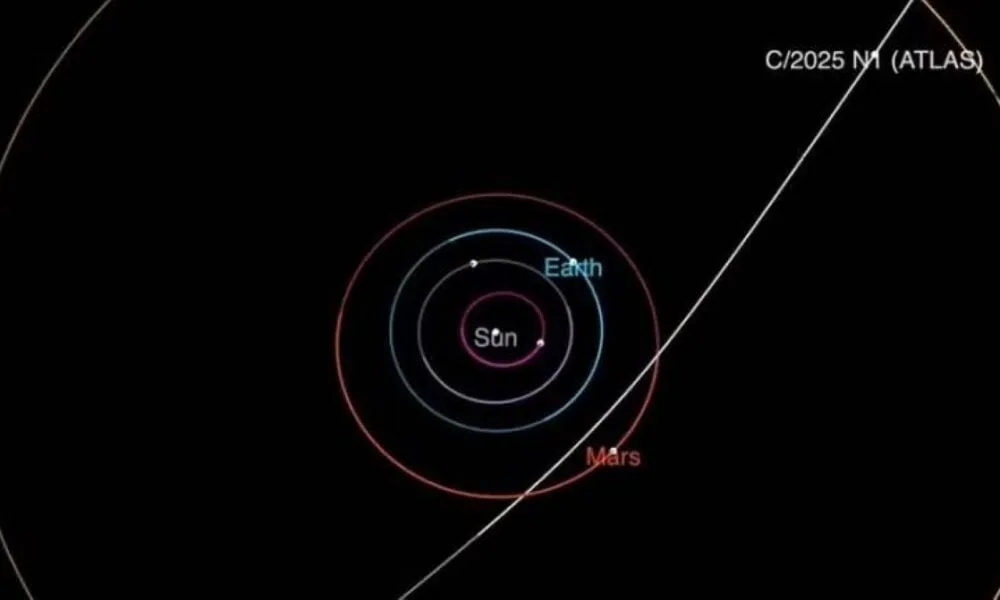

rota do 3I-ATLAS – Foto: NASA/JPL-Caltech
The comet 3I/ATLAS, the third detected interstellar object, crosses the solar system without any collision risk to Earth. Astronomers launched a global observation campaign on October 21 to refine trajectory measurements. The celestial body reaches its closest approach at about 270 million kilometers from the planet.
Experts rule out any threat or artificial nature in the object. The effort involves worldwide telescopes coordinated by the IAWN, a UN-linked network.
- Minimum distance: greater than Earth-Sun separation.
- Visibility period: resumes in December and January.
- Composition: high carbon dioxide levels.
Origin and detection details
The 3I/ATLAS originates from another planetary system. Its recent detection used astronomical observations.
Thiago Signorini Gonçalves, director of Valongo Observatory at UFRJ, emphasizes the event’s rarity. The comet enables comparisons of distant planetary formations.

Chemical composition features
The nucleus shows complex layers with nickel and iron contamination. It expels large amounts of carbon dioxide with low water presence.
Marcelo De Cicco, coordinator of EXOSS.org project, notes early nickel atomic lines. These traits indicate formation in extremely cold regions.
The behavior differs from known solar system comets. High CO2 suggests a frigid primordial environment.
Global monitoring campaign
The IAWN called the action to test tracking protocols. Telescopes face current challenges with the comet behind the Sun.
Plans include equipment use from December to January. The safe distance eliminates impact chances.
Speculations and clarifications
Social media rumors suggested alien spacecraft or collision alert. Brightness and speed variations follow natural comet patterns.
De Cicco states no technological signatures exist. Gonçalves confirms chemical properties stay within scientific expectations.
Scientific opportunities offered
Each interstellar visitor carries unique chemistry and formation history. The 3I/ATLAS acts as a lab for exoplanetary system studies.
Research compares elements with local comets. Collected data improves cosmic evolution models.
The object challenges typical comet nucleus traits. Observations advance understanding of distant cold environments.
Trajectory and orbital data
The comet follows a hyperbolic orbit, confirming one-time solar system passage. High speed indicates ejection from its original system.
Current measurements refine orbital parameters. The international campaign gathers data for astronomical databases.