


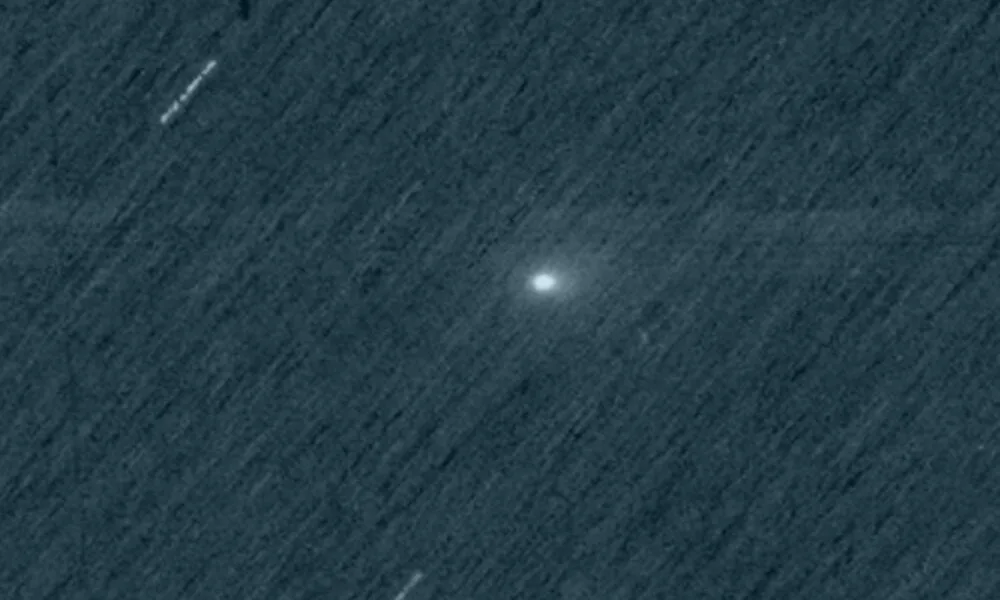

Registro de Cometa 3I Atlas – Agencia Espacial Europeia (ESA) NYT
NASA activated a planetary defense protocol after detecting unusual behavior from the interstellar comet 3I/ATLAS, discovered on July 1, 2025, by the ATLAS telescope in Chile. The object, exhibiting an atypical chemical composition dominated by carbon dioxide, follows a hyperbolic trajectory and will reach perihelion on October 29, 2025. The International Asteroid Warning Network (IAWN) announced a special training exercise to monitor its orbit between November 2025 and January 2026. The action aims to accurately predict the comet’s path, which travels at over 210,000 km/h.
The comet, possibly the oldest ever observed at over seven billion years, has intrigued scientists. Observations from the James Webb Space Telescope revealed a carbon dioxide concentration eight times higher than water, unprecedented in comets. The IAWN emphasized the need for precise measurements to understand the “unique challenges” of 3I/ATLAS.
- Chemical composition dominated by CO₂, with an unusual ratio to water.
- Estimated nucleus size between 320 meters and 5.6 kilometers in diameter.
- Hyperbolic trajectory indicates an origin outside the Solar System.
Discovery and unique features
The 3I/ATLAS was identified by the ATLAS system in Chile and confirmed as interstellar due to its speed and orbit. Its coma, predominantly composed of carbon dioxide, surprised researchers who expected more water.
James Webb observations revealed water emissions at over 450 million kilometers from the Sun, an unusual behavior. The comet’s solid nucleus also shows high chemical activity, even at great distances.
Intensive monitoring
NASA is coordinating global efforts to track the comet, focusing on its unpredictable trajectory. The IAWN exercise, set to begin on November 27, will involve telescopes worldwide.
The goal is to refine orbital calculations and ensure the comet poses no risks. Its high speed complicates detailed data collection.
The comet will pass perihelion on October 29, heightening the urgency of observations. NASA has not yet confirmed any risk of collision with Earth.
Confirmed extrasolar origin
The 3I/ATLAS is a rare interstellar visitor, originating outside the Solar System. Computational models suggest it is over seven billion years old, surpassing the Solar System’s estimated age of 4.6 billion years.
Studies indicate the comet may have formed in a distant star system, traveling through interstellar space for billions of years before entering our cosmic neighborhood. Its chemical composition offers clues about the formation of planetary systems elsewhere in the universe.
Challenges for scientists
The comet’s speed, exceeding 210,000 km/h, requires high-precision equipment for tracking. The James Webb Space Telescope has been crucial for capturing data on its composition.
The carbon dioxide concentration, six times higher than expected, raises questions about chemical processes in interstellar comets. Researchers are racing to decipher these properties before the comet moves farther away.
Ongoing analysis may reveal more about the origin and evolution of 3I/ATLAS. Data collected until perihelion will be critical for studies.
Next steps in research
The scientific community awaits the results of the IAWN exercise, which may clarify the comet’s trajectory. New observations are scheduled until January 2026, using ground and space telescopes.
Significance for space science
Studying 3I/ATLAS offers a unique opportunity to understand interstellar objects. Its composition and age suggest it carries information about the universe’s early stages, predating the Solar System’s formation.