

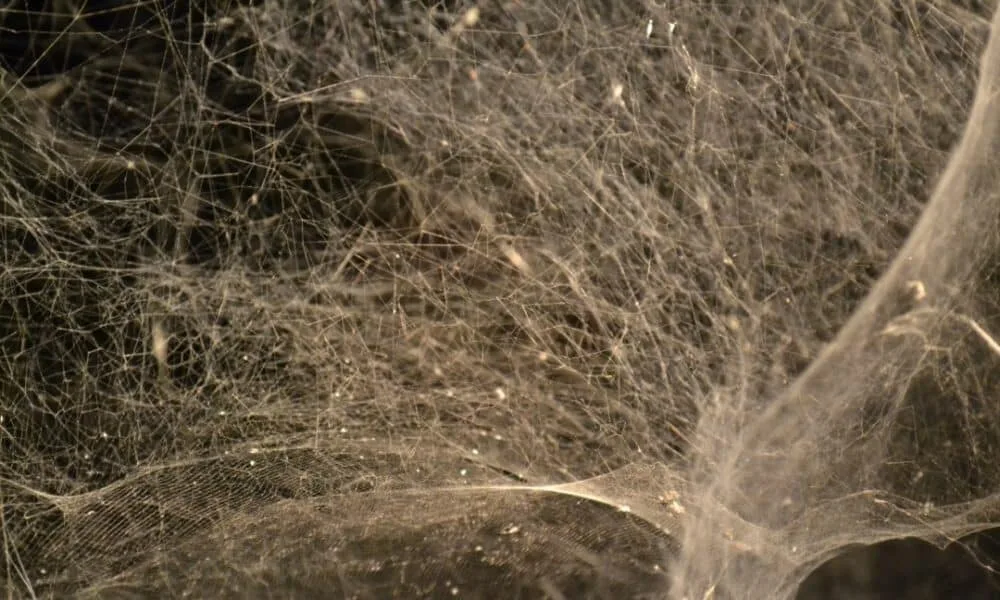

teia de aranha – YBPhotos/Shutterstock.com
A megacolony with around 111 thousand spiders was discovered in the Sulfur Cave, on the border between Greece and Albania, in 2022. The web, which covers 106 square meters, houses two species that coexist in an unprecedented way in an ecosystem powered by bacteria that metabolize sulfur. The finding, published in the journal Subterranean Biology, is surprising due to the adaptation of spiders to an environment without light and toxic air.
The discovery was made by speleologists from the Speleological Society of the Czech Republic, who alerted biologists to study the phenomenon. The web, made up of thousands of funnel-shaped structures, is supported by a peculiar food chain.
- Species: Tegenaria domestica (69 thousand) and Prinerigone vagans (42 thousand).
- Environment: Total darkness, high sulfur concentration.
- Food: Chironomid mosquitoes that consume bacterial biofilms.
Unique underground ecosystem
The Sulfur Cave is a hostile environment, where life depends on chemoautotrophy. Sulfur-oxidizing bacteria form biofilms that feed mosquito larvae.
These mosquitoes, in turn, are the spiders’ main food source, sustaining the megacolony.
Rare behavior between species
The larger Tegenaria domestica spiders build the web, while the smaller Prinerigone vagans occupy opportunistic spaces. Outside the cave, these species are solitary.
Darkness can reduce aggressive interactions, allowing coexistence.
Coexistence in a colony is unprecedented for both species.
Scientists have discovered what might be the largest spider web in the world, found in a cave straddling the border of Greece and Albania. https://t.co/cOOojNwNOo pic.twitter.com/Q355cTvtOV
— ABC News (@ABC) November 11, 2025
Genetic adaptation of spiders
Cave spiders present genetic differences in relation to external populations. DNA analyzes confirmed adaptations to the extreme environment.
Isolation prevents genetic exchanges, favoring unique variations.
The gut microbiota of spiders is less diverse, reflecting their high-sulfur diet.
The study suggests phenotypic plasticity in extreme conditions.
Scientific discovery details
István Urák, from Sapientia University, led the expeditions. He described the find as impressive.
The web starts 50 meters from the entrance, in a narrow passage.
The site was revisited in 2024 for more detailed analysis.
Impact on biological research
The discovery opens up new questions about animal behavior. Cooperation between species challenges traditional concepts.
The cave ecosystem can inspire studies on sustainability.