



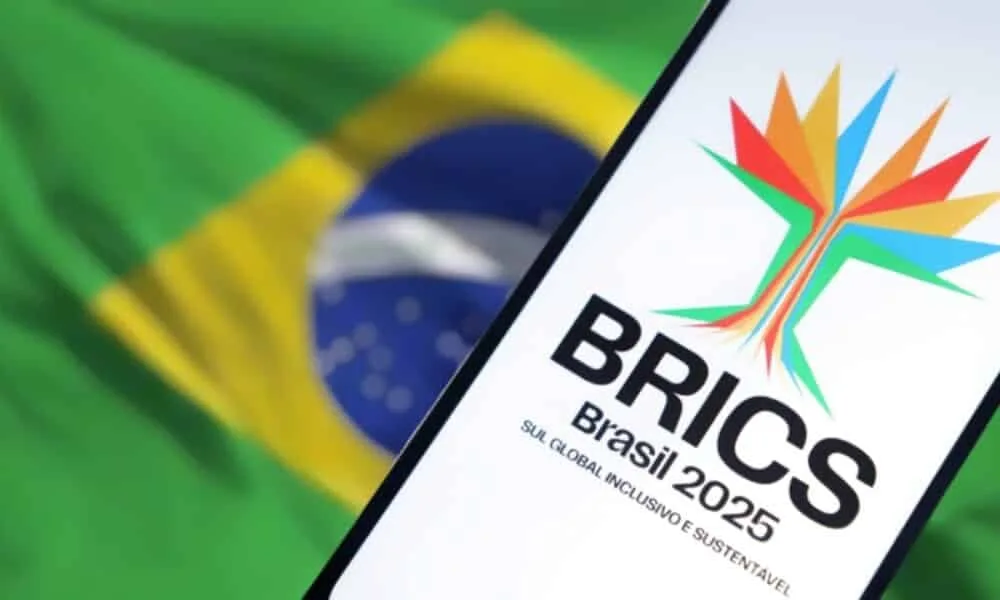

Brics – Foto: Poetra.RH / Shutterstock.com
The BRICS economic bloc, made up of Brazil, Russia, India, China, South Africa and new members such as Egypt, the United Arab Emirates, Ethiopia, Iran and Indonesia, launched BRICS Pay in August 2025, a digital payment system based on Brazil’s Pix. Announced at the Kazan summit in Russia, the platform seeks to facilitate international transactions in local currencies, reducing dependence on the US dollar. Developed with blockchain technology, the system promises fast, secure and low-cost transfers, connecting central banks and financial institutions of member countries. The initiative responds to Western economic sanctions and the need for greater financial autonomy in global trade. Brazil, with its experience in Pix, plays a central role in the development of the project, which could move billions in transactions by 2030.
The creation of BRICS Pay marks a strategic step for the bloc, which seeks to redefine the dynamics of global trade. Already in testing phase under the leadership of China and Russia, the platform integrates existing instant payment systems, such as Pix in Brazil, SBP in Russia and UPI in India, allowing transactions without conversion to the dollar.
- BRICS Pay Goals:
- Promote transactions in local currencies such as real, yuan and rupee.
- Reduce operating costs in international trade.
- Strengthen financial sovereignty against external sanctions.
- Boost the competitiveness of the exports of member countries.
Tecnología inspirada en Pix
Lanzado por el Banco Central de Brasil en 2020, Pix se convirtió en un referente global para pagos instantáneos, manejando el 49% de las transacciones no físicas en Brasil en el primer trimestre de 2025, totalizando R$7 billones. La plataforma permite transferencias 24/7 con costos nulos o bajos, revolucionando el mercado financiero nacional. Su estructura tecnológica, que combina accesibilidad y eficiencia, inspiró a BRICS Pay a crear una solución similar para el comercio global.
Brasil lidera la integración de Pix en el nuevo sistema, aprovechando cinco años de experiencia. En la cumbre de julio de 2025, el presidente Luiz Inácio Lula da Silva destacó el potencial de Pix para transacciones transfronterizas, reduciendo barreras técnicas y costos cambiarios. LEconomist Carla Beni, from the Getulio Vargas Foundation, points out that Brazilian technology can easily adapt to the needs of the bloc, especially with the future integration of Drex, the digital real in development.
Brazil’s experience is also attracting the interest of new BRICS members, such as Egypt and the United Arab Emirates, which are seeking to modernize their payment systems. Pix’s interoperability with other national platforms is seen as a key strength for the viability of BRICS Pay.
Blockchain as an operational basis
BRICS Pay uses the Decentralized Cross-border Messaging System (DCMS), developed by Saint Petersburg State University, capable of processing up to 20,000 transactions per second. Unlike SWIFT, controlled by Western institutions, DCMS operates in a decentralized manner, with each country managing its own node, guaranteeing greater independence.
The choice of blockchain technology ensures security and transparency in transactions. The system is designed to resist external interference, a crucial factor for countries like Russia and China, which face sanctions from 2022.
- DCMS Features:
- High processing capacity with low rates.
- Advanced encryption for data protection.
- Operation without dependence on a central controller.
- Open source planned after testing phase.
Russia leads the testsinitials with bilateral transactions in rubles and yuan, while Brazil plans to integrate Pix by the end of 2026. The technology also allows the inclusion of digital currencies, such as Drex, expanding its applications.
Reactions on the global stage
The launch of BRICS Pay generated tensions with Western powers, especially the United States, where the dollar represents 84% of global transactions. Threats of tariffs of up to 100% to nations that adopt alternative systems to the dollar, expressed by former President Donald Trump, intensified the geopolitical debate. Even so, Russian economist Sergey Glazyev argues that BRICS Pay is vital for the financial sovereignty of the Global South.
In Brazil, the system is seen as an opportunity to strengthen sectors such as agribusiness and mining, dependent on exports to China and India. Eliminating the conversion to the dollar could reduce exchange losses, making Brazilian products more competitive. Professor Marco Aurélio dos Santos Sanfins, from the Fluminense Federal University, highlights that the system can protect economies from external sanctions.
Countries such as Saudi Arabia and Turkey, which are considering joining BRICS, see BRICS Pay as an opportunity to diversify their commercial transactions. The initiative also strengthens the New Development Bank (NBD), which plans to create multilateral guarantees to mitigate financial risks.
Integration of national systems
The success of BRICS Pay depends on the connection between the instant payment systems of member countries. In addition to Pix, which records 227 million daily transactions by September 2025, the block plans to integrateSBP from Russia, UPI from India, IBPS from China and PayShap from South Africa. This interoperability requires technical and regulatory harmonization, a challenge that Brazil plans to lead during its BRICS presidency in 2026.
- Connected payment systems:
- Pix (Brazil): 227 million daily transactions, used by 150 million people.
- SBP (Russia): Allows transfers with telephone number, adopted by 200 institutions.
- UPI (India): Unified interface, leader in digital payments since 2010.
- IBPS (China): Allows yuan transactions on multiple channels.
- PayShap (South Africa): Emerging system focused on financial inclusion.
Digitization of national currencies, such as Drex in Brazil, could facilitate integration, allowing real-time transactions. The Central Bank of Brazil is already testing the integration of Pix with Drex, with implementation planned for 2027.
Benefits for global trade
BRICS Pay promises to reduce operating costs and increase export competitiveness. For Brazil, the platform opens markets such as Iran and the United Arab Emirates, which demand agricultural and energy products. Eliminating conversion to the dollar can make transactions cheaper, attracting investment and strengthening trade associations.
Economists project that by 2030, the system will handle up to 20% of global trade.al, challenging SWIFT’s dominance. The initiative also bolsters the New Development Bank, which plans to finance infrastructure and energy projects in the Global South, reducing dependence on institutions such as the IMF.
The integration of digital currencies, such as the digital yuan and Drex, could expand the reach of BRICS Pay, attracting countries outside the bloc. China is already testing international transactions in digital yuan with Hong Kong and Thailand, a model that could be replicated in BRICS.
Technical and geopolitical obstacles
The implementation of BRICS Pay faces significant barriers, such as the harmonization of financial systems between countries with different regulations. Tax policies and the volatility of local currencies are challenges highlighted by experts. Resistance from Western powers, especially the United States and the European Union, could lead to trade retaliation.
- Main obstacles:
- Harmonization of fiscal and exchange policies among members.
- Technical integration of national payment systems.
- Geopolitical pressures from Western countries.
- Risks of monetary fragmentation and exchange rate instability.
As the bloc’s largest economy, China could seek greater influence, raising tensions with members such as India. Brazil maintains a balanced position, advocating for a multilateral platform that benefits all countries. Your liLeadership will be crucial during the BRICS presidency in 2026 to overcome these barriers.
Strategic role of Brazil
Brazil emerges as a protagonist in the development of BRICS Pay, taking advantage of the experience of Pix and the advances in Drex. Foreign Minister Mauro Vieira highlighted, at the 2025 summit, the importance of a system that promotes financial inclusion and representativeness. Brazil’s presidency in BRICS in 2026 will be key to advancing the implementation of the platform.
The initiative also responds to criticism from the United States, which is investigating Pix for allegedly harming companies such as Visa and Mastercard. The integration of Pix into BRICS Pay reinforces Brazil’s financial sovereignty, positioning it as a leader in financial innovation in the Global South.