



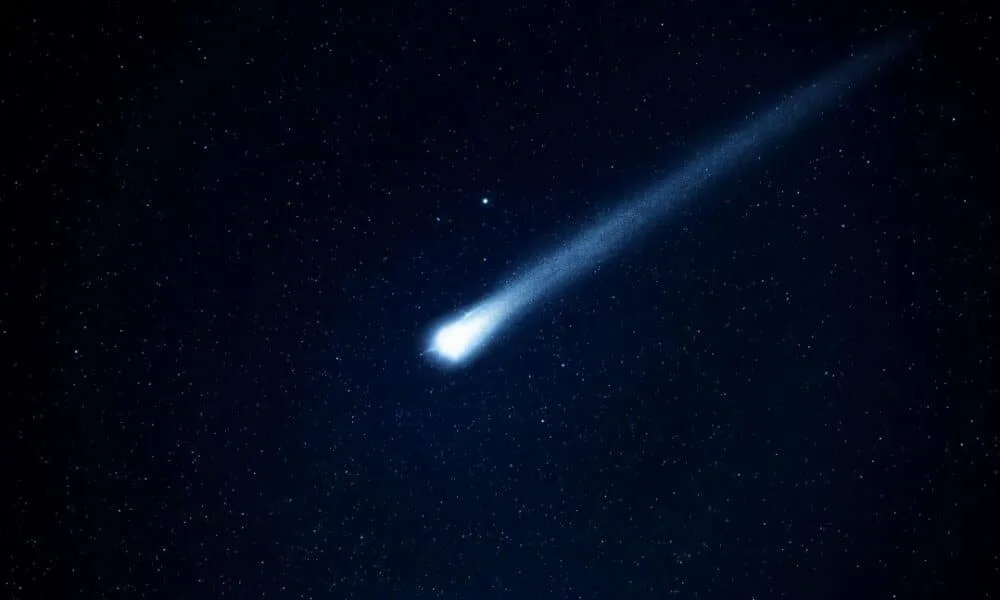

Cometa – Foto: Trifonov_Evgeniy/ iStock
Comet 3I/ATLAS, the third confirmed interstellar object, began moving away from the Sun after reaching perihelion on October 29, 2025, 1.36 astronomical units away.
Astronomers from around the world are preparing equipment to capture images of the visitor, from another star system, who crosses the Solar System for the first time.
Observation will occur mainly in the early morning hours of November and December, with the comet positioned low on the eastern horizon, requiring medium-sized telescopes.
Its hyperbolic trajectory confirms its external origin, and its carbon dioxide-rich composition offers insights into distant planetary formations.
3I/ATLAS Is Not Behind the Sun.
Astronomers were told the interstellar object would disappear behind the Sun during its Oct 29 perihelion. But new observations show that’s not true.On Oct 25, the team recorded 3I/ATLAS visible beside the Sun — not hidden.
Position: RA 13h 38m… pic.twitter.com/cqRoIn8PGT— 3I/ATLAS (@3IAtlas_Anomaly) October 28, 2025
Origin and discovery of 3I/ATLAS
Comet 3I/ATLAS was detected on July 1, 2025 by the ATLAS system, installed in Chile, when it was approximately 670 million kilometers from the Sun, close to the orbit of Jupiter.
Initial observations revealed cometary activity, with a coma and tail formed by sublimation of ice under solar radiation.
The object follows a high-speed route, exceeding 210 thousand kilometers per hour, which prevents it from being captured by the Sun’s gravity.
Trajectory through the Solar System
Entry into the Solar System occurred through the direction of the constellation Sagittarius, close to the center of the Milky Way.
Perihelion marked the point of greatest heat and light, activating jets of dust and gas without causing fragmentation.
In December, the comet will reach its closest approach to Earth, at 1.8 astronomical units, or about 269 million kilometers.
In early 2026, it will pass close to Jupiter before leaving the Solar System permanently.
Observation Requirements
Equipment with a minimum opening of 20 centimeters is essential to detect the 11.5 magnitude brightness.
Places with dark skies and a clear horizon avoid interference from morning twilight.
The ideal duration for searches is around an hour before sunrise.
Applications like TheSkyLive help with the precise location of the object.
Positions in the night sky
From November 3rd, 3I/ATLAS appears at 9 degrees above the eastern horizon, in the constellation Virgo.
- Between November 3rd and 17th: crosses Virgo, gradually rising every dawn.
- From November 18th to 30th: transits to the constellation Leo, with greater elongation of the Sun.
- In December: peak visibility in the northern hemisphere, but accessible in the south with adjustments.
These changes occur due to the retrograde orbit, opposite to most local comets.
Global monitoring campaign
The International Asteroid Warning Network coordinates observations from November 27, 2025 to January 27, 2026.
Telescopes like Gemini South in Chile have captured deep images of the reddish coma, indicative of evolving dust.
NASA probes, including Europa Clipper, may intercept tail particles in November.
- ESA’s Juice Mission: sessions scheduled on November 2nd and 25th to analyze the tail structure.
- TESS satellite: recorded early activity in May 2025, 6.4 astronomical units from the Sun.
These efforts aim to measure the core, estimated to be between 0.6 and 5.6 kilometers in diameter.
Chemical composition revealed
Analysis by the James Webb Space Telescope detected high levels of carbon dioxide in the coma, an unprecedented concentration in comets.
The presence of volatile ices and rare metals differentiates 3I/ATLAS from local objects such as Oumuamua and Borisov.
The core, formed billions of years ago, preserves traces ofa primitive star system, possibly ejected by gravitational interactions.
Studies indicate an age greater than seven billion years, making it the oldest comet observed.
Differences with predecessors
Compared to 1I/Oumuamua, without a clear tail, 3I/ATLAS displays a well-defined coma and tail.
Different from 2I/Borisov, it has a larger diameter and activity at cold distances, with a prominent solar plume.
Its reddish color in the coma suggests a surface evolving under radiation.
These variations reinforce the diversity of interstellar bodies in the galaxy.
Visibility of 3I/ATLAS ends in December 2025, after which the comet heads into deep space, leaving valuable data for future missions.