




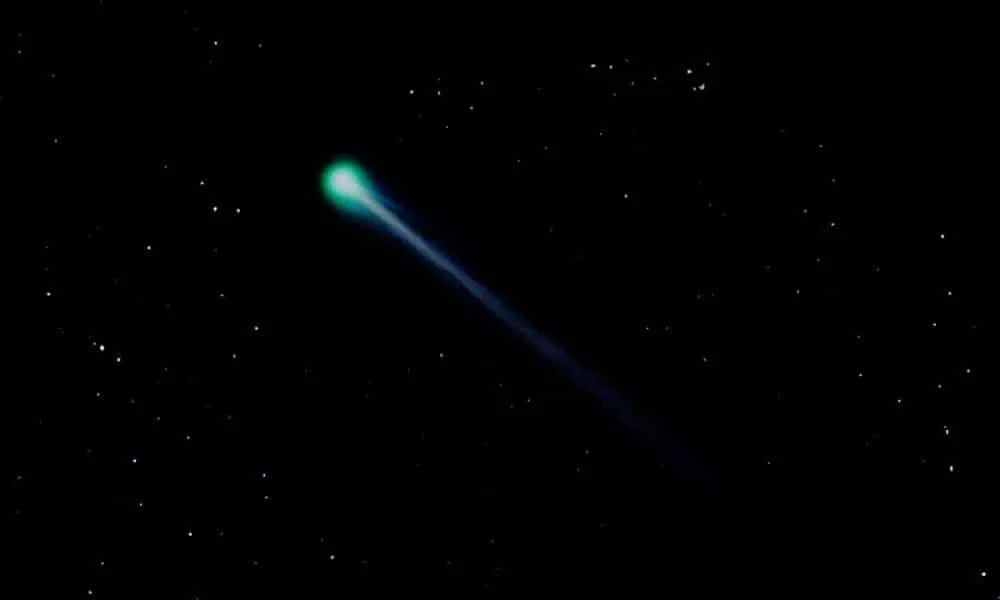

cometa – Foto: Domenichini Giuliano / Shutterstock.com
The interstellar comet 3I/ATLAS, discovered in July 2025 by the ATLAS survey in Chile, exhibits early fragmentation signs due to solar thermal stress. NASA and European Space Agency (ESA) astronomers report accelerated gas and dust release as the object nears perihelion.
This activity occurs at 1.4 astronomical units from the Sun, roughly 210 million kilometers, on Thursday, October 30, 2025. The comet’s composition, rich in volatile ices, drives the rapid response to rising temperatures.
Hubble Space Telescope images capture the reddish coma, signaling fine dust exposed to interstellar radiation over billions of years.
- Hawaii and Chile telescopes log daily brightness changes.
- Spectroscopic scans detect high carbon dioxide levels.
- International teams coordinate data to forecast future outbursts.
Hyperbolic orbit confirms external origin
The 3I/ATLAS travels at 58 kilometers per second, exceeding solar escape velocity.
Orbital simulations differentiate it from local Oort Cloud objects.
Perihelion represents the stress peak, where thermal and tidal forces challenge the sub-kilometer nucleus.
Chemical makeup sets it apart from solar comets
James Webb Space Telescope data show low water content, dominated by carbon monoxide and rare organics like cyanide. This spectral profile indicates formation in a hydrogen-poor stellar environment.
Comparisons with prior visitors, such as 2I/Borisov, reveal dust and volatile variations. Extreme negative polarization highlights grains shaped by prolonged galactic radiation.

Advanced telescopes intensify tracking
Keck Observatory in Hawaii measures infrared emissions from ongoing ice sublimation.
Teams calculate mass loss rates, projected at up to 20% post-perihelion via computational models. Weekly brightness updates track the coma, spanning about 3 arcseconds. NASA’s TESS satellite noted early activity in May 2025, extending the observation record.
Heating triggers rapid gas ejections
Gas jets erupt from the nucleus under 33 gigawatts per square meter of solar flux. Fissures widen, as captured by the Nordic Optical Telescope in the Canary Islands. Dust production follows a power law, scaling with heliocentric distance to the -3.8.
No outbursts yet suggest initial stability, but partial breakup probability rises.
Potential debris creates detectable trails
Simulations predict breakup fragments forming a dust lane visible to ground radars. Such remnants could produce Earth-viewable meteors in 2026, with zero collision risk.
Orbital models rule out impacts, with closest Earth pass at 270 million kilometers in December.
Forecasts target planetary encounters
In November 2025, 3I/ATLAS nears Venus at 97 million kilometers, enabling remote study by ESA’s JUICE mission.
By March 2026, it crosses Jupiter’s orbit at 54 million kilometers, potentially imaged by Juno. These events yield data on gravitational effects on interstellar bodies.
The shift from anti-tail to standard configuration occurred in September, per Nordic Optical Telescope.
Analysis estimates ancient formation age
Estimates place the comet’s age at 7.6 to 14 billion years, tied to the Milky Way’s thick disk.
This galactic region, rich in old stars, explains low heavy element levels.
The object preserves pristine materials from distant systems, aiding chemical evolution models.
Post-perihelion views in December 2025 will track fading to magnitude 12.